Metallic character 4 Periodic trends. Use your notes to answer the following questions.
Periodic Trends In Atomic Size Ck 12 Foundation
Lets break down the trend into its period and group trends.

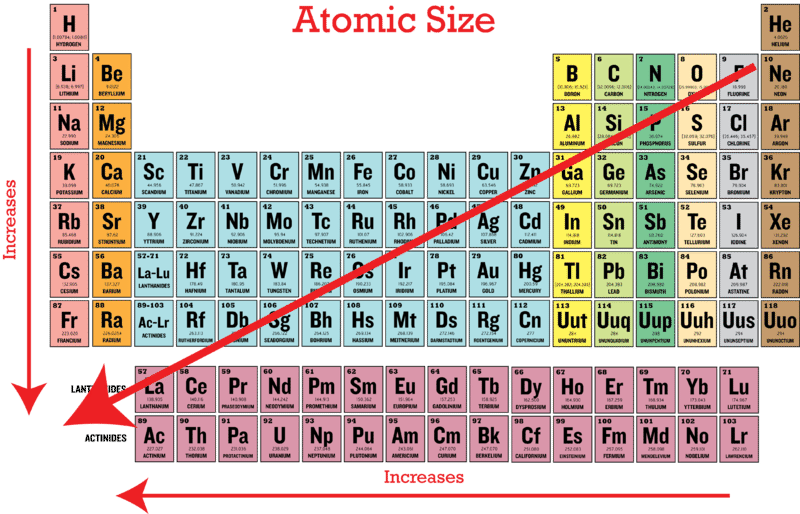
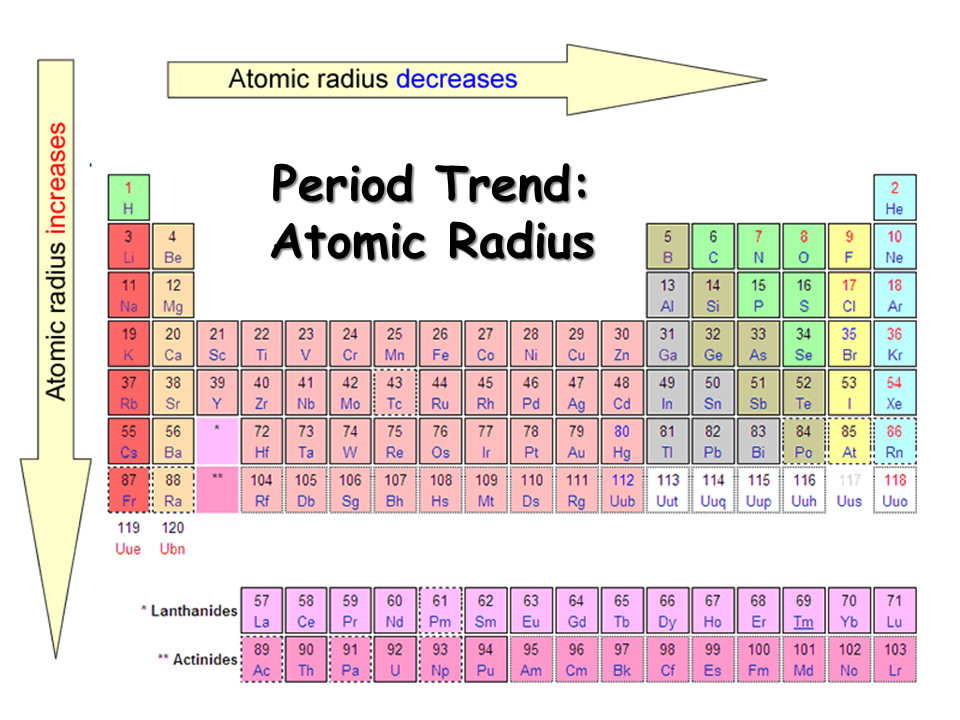
. Atomic radii increase toward the bottom left corner of the periodic table with Francium having the largest atomic radius. Atomic radius electron affinity electron cloud energy level group ion ionization energy metal nonmetal nucleus period periodic trends picometer valence electron Prior Knowledge Questions Do these BEFORE using the Gizmo 1. The atomic radius of atoms generally decreases from left to right across a period.
Trend in atomic radius. Atomic Radius Trend on the Periodic Table. Thus helium is the smallest element and francium is the largest.
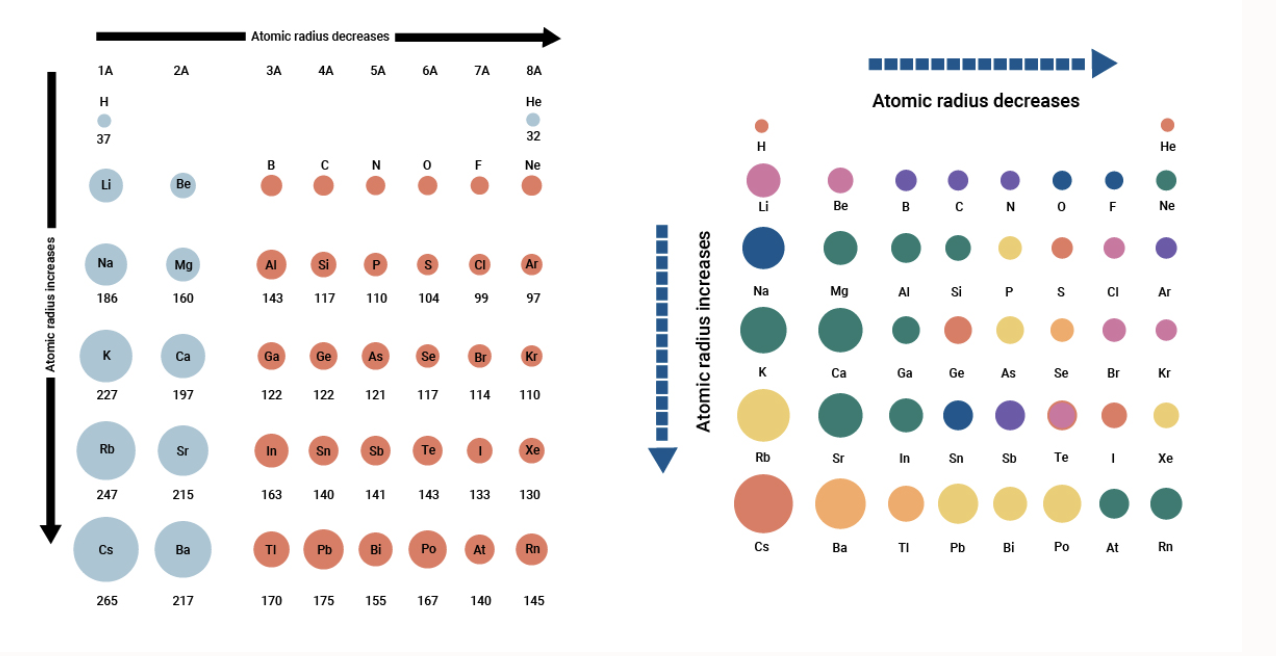
Atomic radii vary in a predictable way across the periodic table. Because more protons are being added to nucleus the positive force is greater furthermore. There are some small exceptions such as the oxygen radius being slightly greater than the nitrogen radius.
In a group the atomic size increases due to the addition of shells as we move from one period to another. In this video we will learn how the atomic radius of elements change as you move across the periodic table. There is an atomic radius trend on the periodic table of elements where atoms with more orbitals have larger atomic radii and atoms with more protons tend to.
What trend does the atomic radius along a period on the periodic table. C is in the same period as B and Cs atomic number is less than Bs. Trends in the Periodic Table A discussion of the periodic trend in atomic radius.
There are some small exceptions such as the oxygen radius being slightly greater than the nitrogen radius. While the atomic radius can be defined in a number of different ways the general atomic radius trend across the periodic table holds true. Atomic radius decreases across a Period from left to right of the Periodic Table 2.
Ionic radius of an. Arrange the following atoms in order of decreasing atomic radius. The atomic bonds restrict the electrons and nucleus and due to this the ions or atoms dont have a specific shape.
Which paper clip would be. In general for the main group elements of the periodic table. The distance between the centre of the nucleus and the outermost shell of an atom is known as the atomic radius.
Within a period protons are added to the nucleus as electrons are being added to the same principal energy level. Atomic radius 3 Periodic trends. The atomic radius gets larger the farther.
Because all the elements in a period are in the same energy level Electrons are the same distance away from the nucleus however because youre continually adding more protons the nucleus is better at attracting the electrons therefore decreasing the radius. Within a period protons are added to the nucleus as electrons are being added to the same principal energy level. The atomic radius of atoms generally decreases from left to right across a period.
The atomic radius decreases along a period. On the image at right the two magnets are the same. Across a period.
An atom does not have a fixed sizeOrdinarily the atomic radius is taken to be one half the distance of closest approach between atoms in an elemental substance. Sn Sb Te Ga As. Atoms decrease in size across the period and increase in size down the group.
In general atomic radii-decreases across the period from left to right in the periodic table. Ionic radius is the distance from the nucleus to the outer edge of the electron cloud of an ion. As a result the valence electrons are held closer to the nucleus and the atomic radius decreases.
Within a period protons are added to the nucleus as electrons are being added to the same principal energy level. Elements A B and C have following relations. The same trend of atomic radius applies once you divide the table into metal and nonmetal sections.
As can be seen in the figures below the atomic radius increases from top to bottom in a group and decreases from left to right across a period. The atomic radius increases as you move down a column because for every new row of the table a new electron. What trend does the atomic radius follow along a period on the periodic table.
The chart below shows the relative sizes of atoms. Atomic size decreases across the period from left to right and it increases down the group from. Atomic Radii Decrease From Left to Right.
Increases down a group in the periodic table. Ill explain to you the variation of following properties in the periodic table. Periodic Trends Worksheet.
The atomic radius of atoms generally decreases from left to right across a period. B is in the same group as A and Bs period number is larger than As. The following trend in periodic properties of elements is observed.
The atomic radius for atoms of an element tends to go up as you move down a group of elements in the table. As you go down in the columns you increase the. Metals Nonmetals Ionic radius increases Ionic radius increases.
The atomic radius of atoms generally decreases from left to right across a period. Within a period protons are added to the nucleus as electrons are being added to the same principal energy level. You already know about the atomic size trend in periodic table.
Ga As Sn Sb Te. 2 Periodic trends. There are some small exceptions such as the oxygen radius being slightly greater than the nitrogen radius.
119 rows Atomic Radius Trend 1. This results in a larger atomic radius. A cation has a smaller.
Atomic radius 1 increases down a Group from top to bottom of the Periodic Table. The atomic radius gets smaller the farther right it appears on the periodic table. The measuring unit for the ionic radius is Armstrong A 0 or picometers pm.
There are many trends on the periodic table. Atomic radius is one half the distance between the nucleus of two bonding atoms. The atomic radius stays constant across the periodic table.
The characteristic radius ranges from 30 to 200 pm. The atomic radius increases as the number of protons increases across the table. The ionic radius is the radius of an atom forming an ionic bond or an ion.
There are some small exceptions such as the oxygen radius being slightly greater than the nitrogen radius.

Periodic Trends Made Easy Chemtalk
What Are The Periodic Trends For Atomic Radii Ionization Energy And Electron Affinity Socratic
Atomic Radius Trend Periodic Table Chemtalk
Atomic Radius Of Elements


0 Comments